Why These Tiny Pollinators Matter More Than You Might Think
Imagine walking into a garden on a warm spring morning.
The flowers are blooming.
Butterflies drift gently through the air.
Birds are singing from the trees.
But something feels different.
There isn’t a single buzz.
No bumblebees weaving between blossoms.
No honeybees collecting nectar.
No tiny insects disappearing deep inside colourful flowers before flying on to the next one.
At first, you might think it wouldn’t make much difference.
After all, bees are small creatures.
But if every bee suddenly disappeared, the world around us would slowly begin to change in ways most people have never imagined.
The answer might surprise you.
P.S. There’s a bonus if you read all the way to the end!
The Quick Answer
🐝 If bees disappeared, many flowering plants would struggle to reproduce because they rely on bees and other pollinators to move pollen from one flower to another.
🐝 Over time, this would affect wildflowers, wildlife, many fruits and vegetables, and the ecosystems that support life on Earth.
🐝 Thankfully, bees haven’t disappeared, and there are many simple ways we can help protect them. Understanding why they matter is the first step.
Tiny Creatures with an Enormous Job
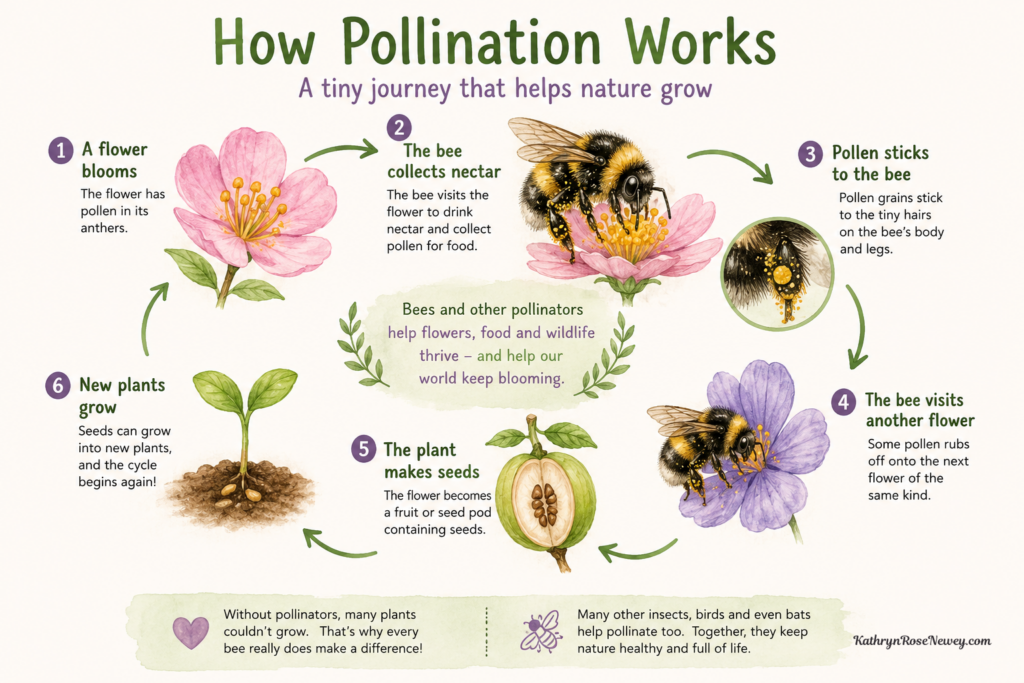
As bees move from flower to flower collecting nectar and pollen, tiny grains of pollen stick to their furry bodies. When some of that pollen rubs off onto the next flower, it helps many plants produce seeds and fruit.
The next time you see a bee disappear into a flower, remember – you’ve just watched one of nature’s oldest partnerships at work.
More Than Just Honeybees
Many people imagine that all bees are honeybees.
In reality, there are around 20,000 known species of bees worldwide, including around 270 species found in the UK.
Some live in large colonies, like honeybees.
Others, called solitary bees, live alone and make tiny nests in hollow stems, old walls, sandy banks or even holes in wood.
There are also the familiar, fluffy bumblebees, whose deep buzzing sound is often heard in gardens during spring and summer.
Each species plays its own part in pollinating plants.
Some bees even have special abilities. Certain bumblebees perform something called buzz pollination. They vibrate their flight muscles so powerfully that pollen is shaken loose from flowers such as tomatoes, blueberries and aubergines—plants that many other pollinators simply can’t pollinate as effectively.
Nature has evolved these remarkable partnerships over millions of years.
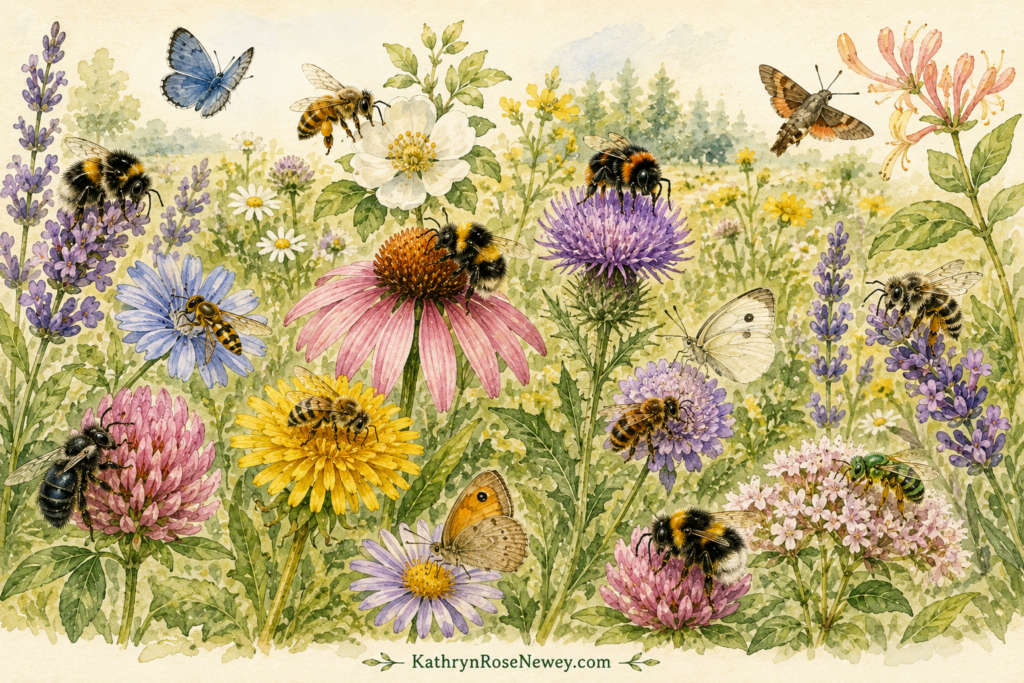
A World Connected by Flowers
It’s easy to think of a flower as just something beautiful to look at.
But every flower is part of a much bigger story.
Wildflowers provide nectar and pollen for insects.
Insects become food for birds.
Birds help spread seeds.
Plants provide shelter for mammals.
Trees grow from seeds produced after successful pollination.
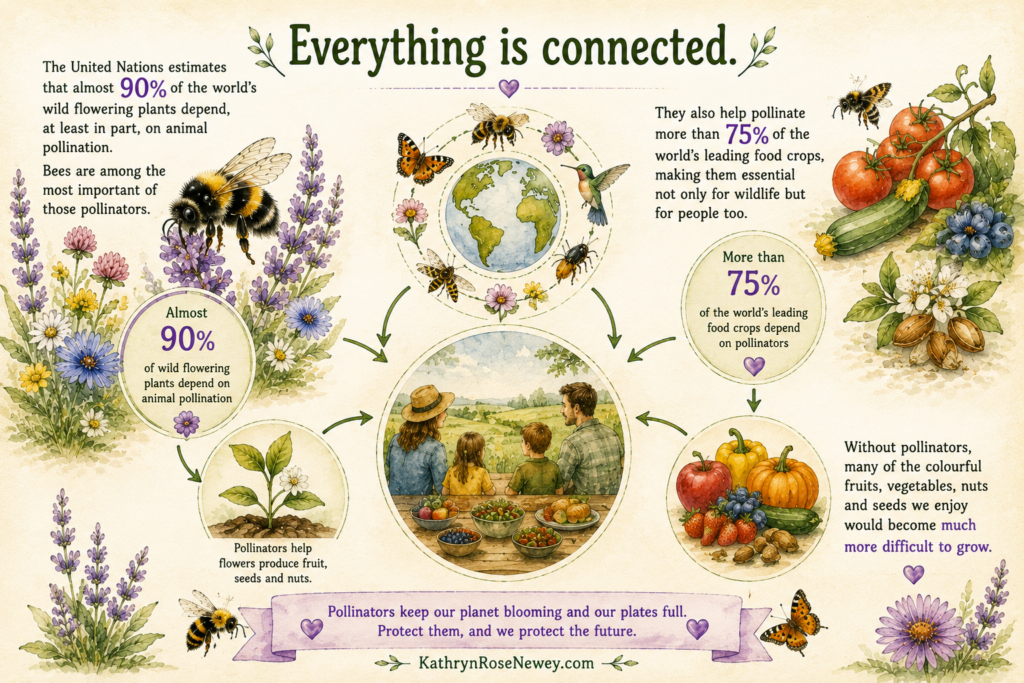
Everything is connected.
The United Nations estimates that almost 90% of the world’s wild flowering plants depend, at least in part, on animal pollination. Bees are among the most important of those pollinators.
They also help pollinate more than 75% of the world’s leading food crops, making them essential not only for wildlife but for people too.
Without pollinators, many of the colourful fruits, vegetables, nuts and seeds we enjoy would become much more difficult to grow.
So… What Would Happen if Bees Disappeared?
Thankfully, scientists are not saying that bees are about to disappear completely.
However, many bee species are declining in different parts of the world because of habitat loss, changes in land use, some pesticides, diseases, parasites and climate change.
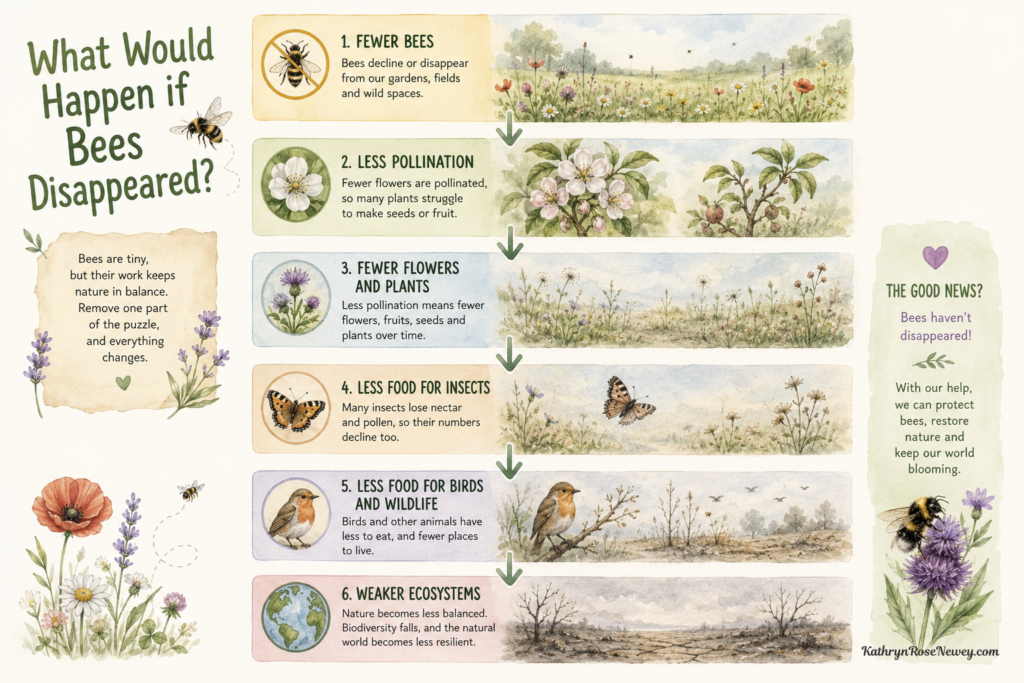
Thinking about what would happen if bees disappeared helps us understand why protecting them matters so much.
If there were no bees, the changes wouldn’t happen overnight.
Instead, they would happen gradually, like pieces being removed from a giant nature puzzle.
Many flowering plants would struggle to produce seeds.
Fewer wildflowers would grow.
Some insects would lose important sources of food.
Birds and small mammals that depend on those insects or seeds could also be affected.
Over time, entire ecosystems could become less healthy and less diverse.
People would notice changes too.
Many fruits, vegetables, nuts and other crops that benefit from bee pollination could become scarcer, more expensive or produce smaller harvests.
Scientists are even researching alternatives such as hand pollination or robotic pollinators, but these could never replace the incredible work that billions of bees carry out naturally every single day.
One tiny bee might not seem important.
But together, millions of bees quietly help keep the natural world blooming.
Nature’s Smallest Heroes
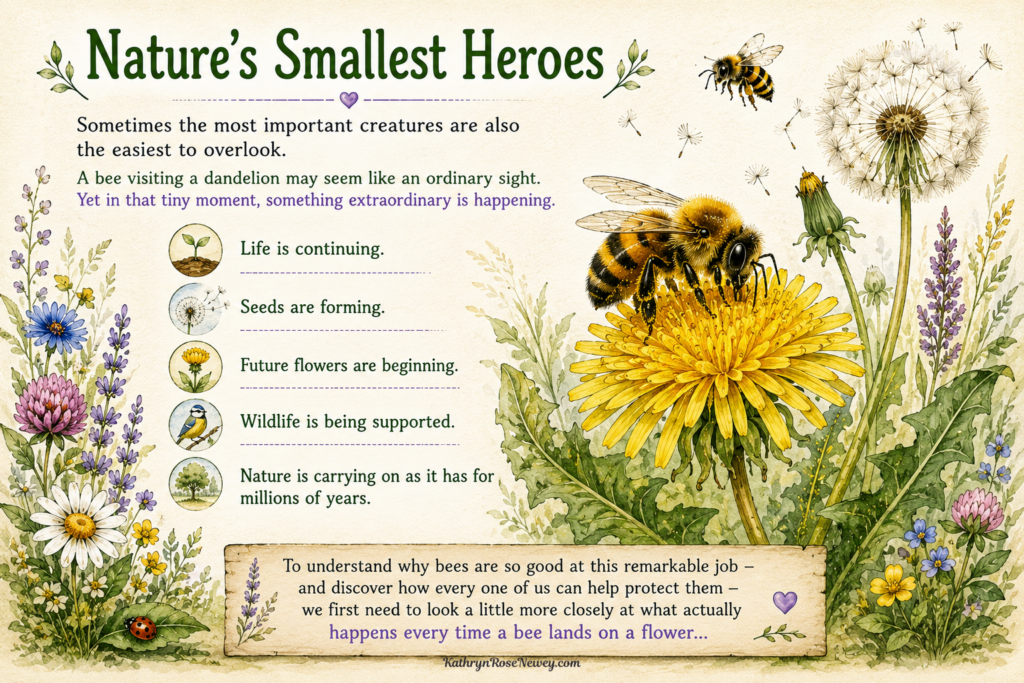
Sometimes the most important creatures are also the easiest to overlook.
A bee visiting a dandelion may seem like an ordinary sight.
Yet in that tiny moment, something extraordinary is happening.
Life is continuing.
Seeds are forming.
Future flowers are beginning.
Wildlife is being supported.
Nature is carrying on as it has for millions of years.
To understand why bees are so good at this remarkable job – and discover how every one of us can help protect them – we first need to look a little more closely at what actually happens every time a bee lands on a flower…
How Do Bees Help Flowers?
Have you ever watched a bee disappear right inside a flower?
It might look as though it’s simply having a little snack!
In fact, that bee is busy collecting two important things:
- 🌼 Nectar – a sweet liquid that provides energy.
- 🌼 Pollen – a powdery substance that contains the plant’s male cells. Bees collect pollen because it’s packed with protein, making it excellent food for growing bee larvae.
As the bee squeezes into the flower, pollen sticks to the tiny hairs covering its body.
When it flies to another flower of the same kind, some of that pollen rubs off.
That simple journey allows the second flower to produce seeds and, in many plants, fruits too.
The amazing thing is that the bee isn’t trying to help the flower.
It’s simply looking for food.
Nature has created a partnership where both the flower and the bee benefit.
Scientists call this a mutual relationship, and it has been evolving for millions of years.
Did You Know?
🐝 Bees don’t visit flowers because they know plants need help.
🐝 They’re simply collecting nectar and pollen for themselves and their young.
🐝 Helping plants reproduce is a wonderful side effect!
Why Are Bees Such Good Pollinators?
Lots of insects visit flowers.
So why are bees considered the superstars?
One reason is their furry bodies.
Those tiny hairs act almost like Velcro, trapping pollen as bees crawl around inside flowers.
Unlike butterflies or flies, bees also deliberately collect pollen, packing it onto their back legs or underneath their bodies to carry home.
That means they visit hundreds of flowers every day while carrying lots of pollen with them.
Some bee species are even more remarkable.
Certain bumblebees can perform something called buzz pollination.
Instead of simply landing on a flower, they vibrate their powerful flight muscles at just the right frequency to shake pollen loose.
Plants such as tomatoes, blueberries and aubergines rely heavily on this special skill.
It’s something that many other insects simply cannot do.
Nature has given different bee species different “superpowers”!
Can You Spot These UK Bees?
The UK is home to around 270 different species of bees, each with its own way of helping nature. Some live in large colonies, while others live alone. Some are fluffy bumblebees that can buzz-pollinate certain flowers, while others are tiny solitary bees that quietly pollinate fruit trees or build nests from pieces of leaves.
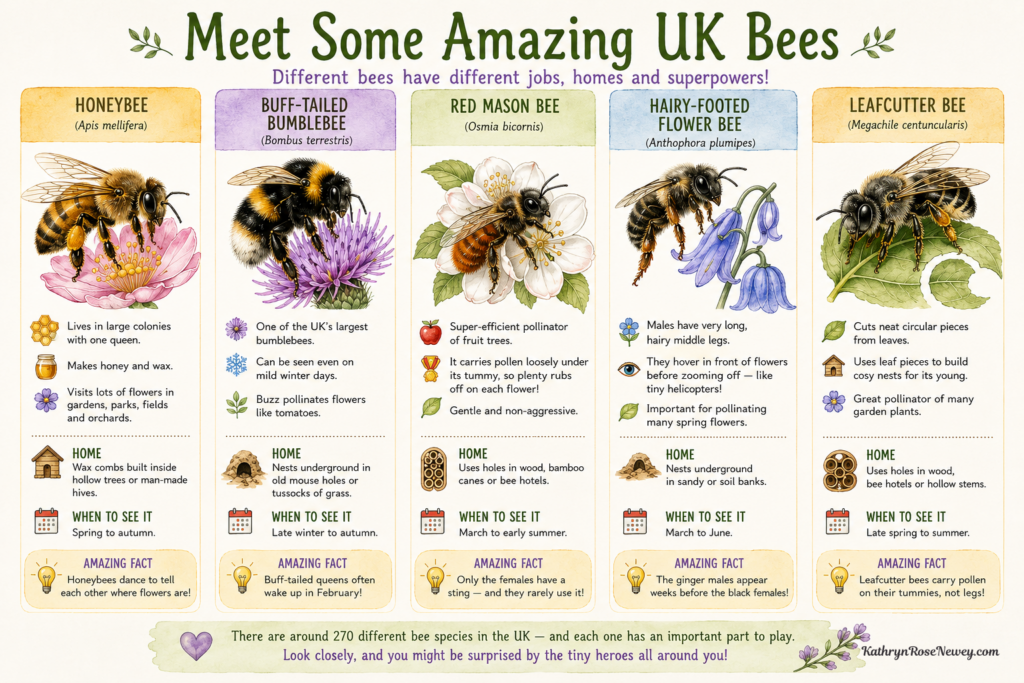
The infographic above introduces five fascinating examples:
- Honeybees are our familiar hive-dwelling bees, famous for making honey and pollinating many garden flowers and crops.
- Buff-tailed Bumblebees are among the UK’s largest and fluffiest bees, often seen surprisingly early in the year.
- Red Mason Bees are gentle solitary bees that are especially important pollinators of fruit blossom.
- Hairy-footed Flower Bees are speedy spring visitors, with hovering males that are fun to watch in gardens.
- Leafcutter Bees are remarkable little architects that cut neat circles from leaves to build cosy nests for their young.
Each species plays a different role, but together they help keep our gardens, countryside and ecosystems healthy.
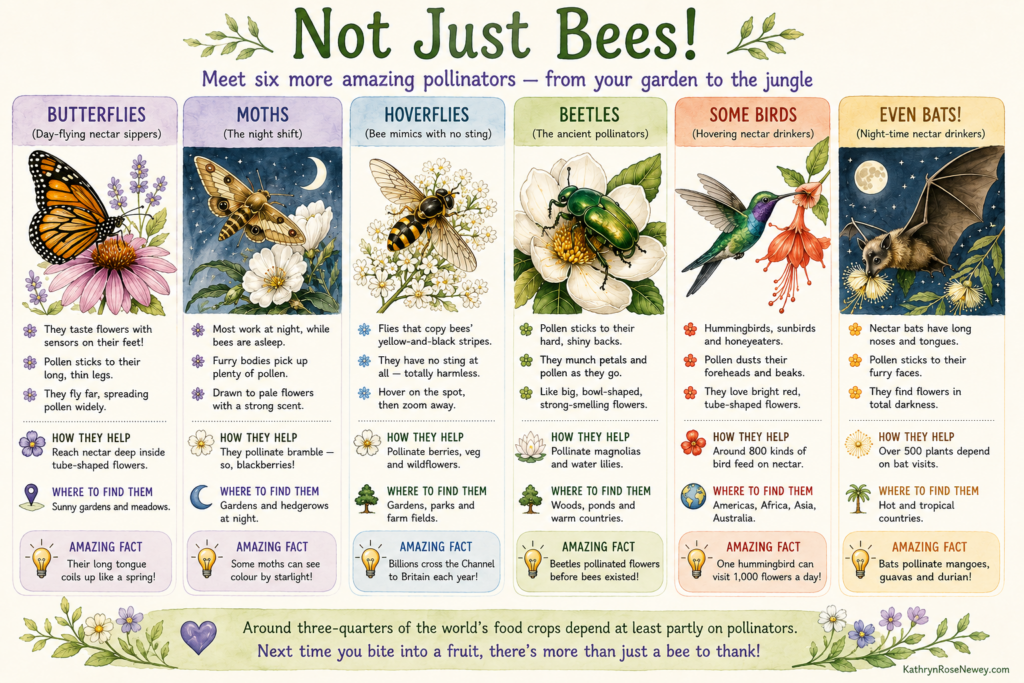
It’s Not Just Bees…
Although bees are some of the world’s most important pollinators, they don’t work alone.
Many other animals help plants too.
These include:
🦋 Butterflies
🌙 Moths
🦟 Hoverflies
🐞 Beetles
🦃 Some birds
🦇 Even bats in some parts of the world.
Together, these pollinators help keep ecosystems healthy.
If one group declines, the others become even more important.
That’s one reason scientists encourage us to protect all pollinators, not just honeybees.
Did You Know?
🦟 Some hoverflies look almost exactly like bees!
🦟 They’re harmless, but by looking like bees they help scare away predators. Can you tell the difference?
Why Are Bees Facing Challenges?
The good news is that bees haven’t disappeared.
The worrying news is that many species are finding life much harder than they used to.
Scientists have identified several reasons why.
🌼 Fewer Wildflowers
Many meadows and wildflower-rich habitats have disappeared.
That means bees have fewer places to find food.
🚜 Changes in Farming
Large areas growing just one crop may provide lots of flowers for a short time…
…but afterwards there may be very little food available for bees.
🏡 Habitat Loss
As towns and cities grow, some nesting places disappear.
Different bee species need different homes.
Some nest underground.
Some use hollow stems.
Others use old walls or dead wood.
🧪 Pesticides
Scientists continue to study how some pesticides affect different bee species.
Reducing unnecessary pesticide use and creating bee-friendly habitats can help support healthy pollinator populations.
🌍 Climate Change
Changing weather changes when flowers bloom.
Sometimes bees emerge expecting flowers to be available…
…only to find that flowering happened earlier than usual.
Nature depends on good timing.
When plants and pollinators become out of sync, both can struggle.
Here’s the Good News… You Can Help!
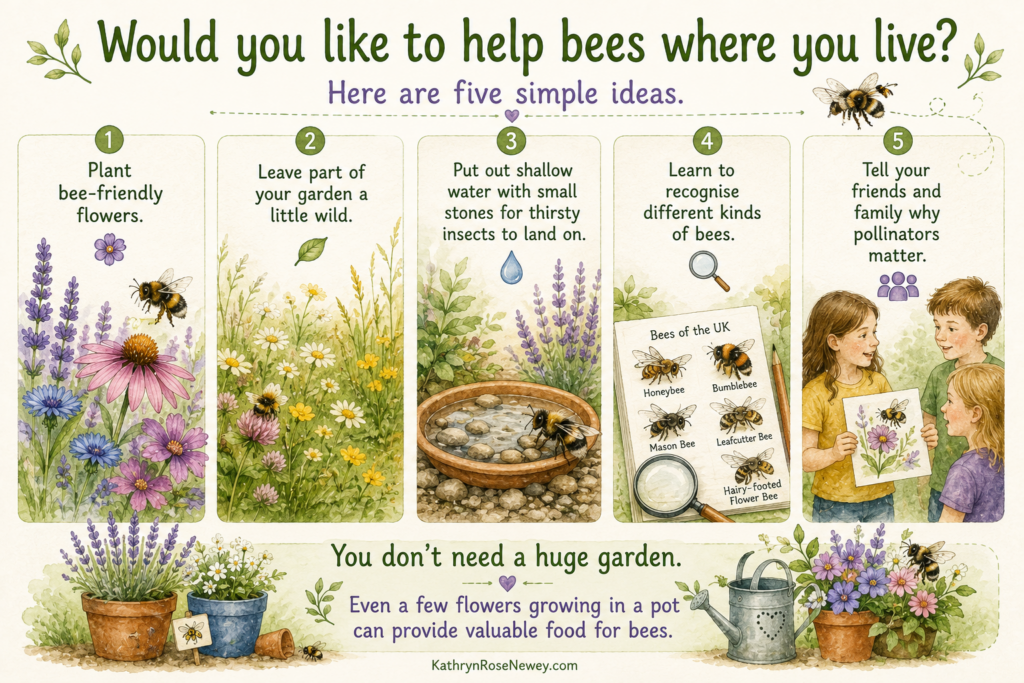
Would you like to help bees where you live?
Here are five simple ideas.
🌸 Plant bee-friendly flowers.
🌸 Leave part of your garden a little wild.
🌸 Put out shallow water with small stones for thirsty insects to land on.
🌸 Learn to recognise different kinds of bees.
🌸 Tell your friends and family why pollinators matter.
You don’t need a huge garden.
Even a few flowers growing in a pot can provide valuable food for bees.
Try This!
Take the Nature Detective Challenge:
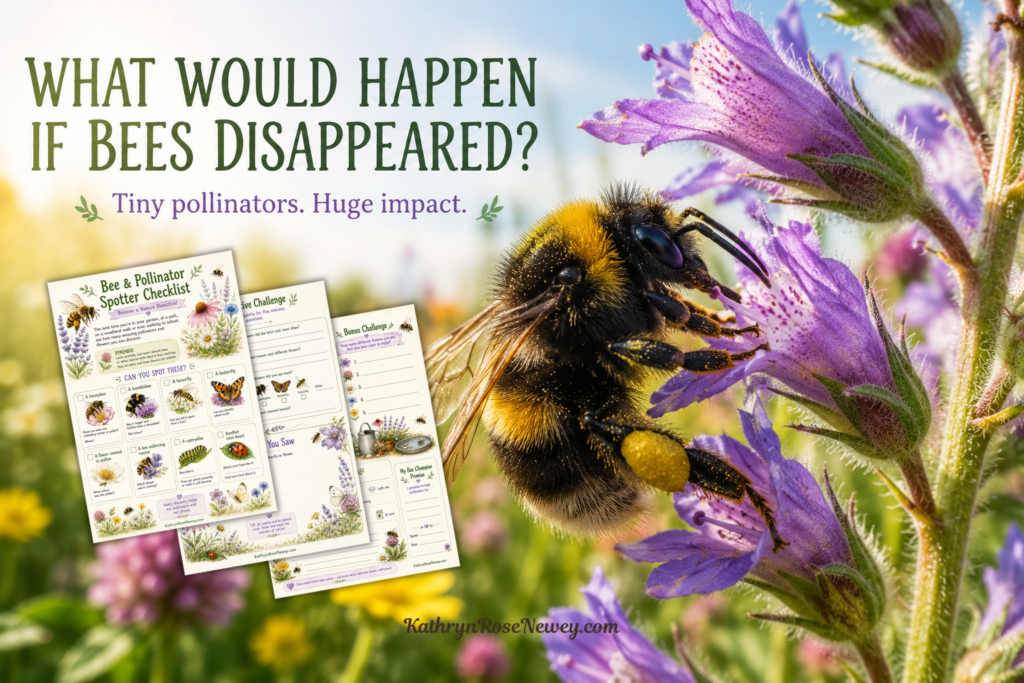
Turn what you have learned into a real outdoor activity with my free Bee & Pollinator Spotter Checklist (3-page A4-size PDF).
Use it in the garden, at the park, on a nature walk or even on the journey to school. Children can record the pollinators they spot, watch which flowers bees prefer and choose simple actions to help them.
This free checklist is one activity from my Eco Wonder resources. Eco Wonder Community members receive access to the complete resource library, including worksheets, posters, diagrams and new learning activities.
Frequently Asked Questions About Bees
What would happen if bees disappeared?
If bees disappeared, many flowering plants would struggle to reproduce because they rely on bees to carry pollen from one flower to another. Over time, this would mean fewer wildflowers, less food for many insects and animals, and lower harvests of some fruits, vegetables and nuts that benefit from bee pollination. Thankfully, bees haven’t disappeared, and by protecting habitats and supporting pollinators, we can all help keep nature healthy and thriving.
Would humans survive without bees?
Yes – but life would be very different.
Many important crops, such as wheat, rice and maize, are pollinated by the wind rather than insects, so they would still grow. However, many fruits, vegetables, nuts and seeds benefit from bee pollination. Without bees, these foods would become much harder and more expensive to produce, and ecosystems around the world would become less healthy. The good news is that bees haven’t disappeared, and there is still time to help protect them.
Are honeybees the only pollinators?
No. Honeybees are probably the best-known pollinators, but they are only one part of a much bigger team.
Bumblebees, solitary bees, butterflies, moths, hoverflies, beetles, some birds and even bats all help pollinate flowers in different parts of the world. Protecting a wide variety of pollinators helps keep nature healthy and resilient.
Why are bees disappearing?
Scientists believe there isn’t just one reason.
Many bee species are affected by a combination of habitat loss, fewer wildflowers, changes in farming, climate change, diseases, parasites and some pesticides. Different species face different challenges depending on where they live, which is why protecting habitats is so important.
How can children help bees?
You don’t need a huge garden to make a difference.
Children can help by:
- planting bee-friendly flowers
- leaving wild patches for insects
- providing shallow water for pollinators
- learning to identify different bee species
- telling friends and family why pollinators matter
- taking part in school or community wildlife projects
Even a few flowers growing in a window box can provide valuable food for bees.
Every Small Action Matters
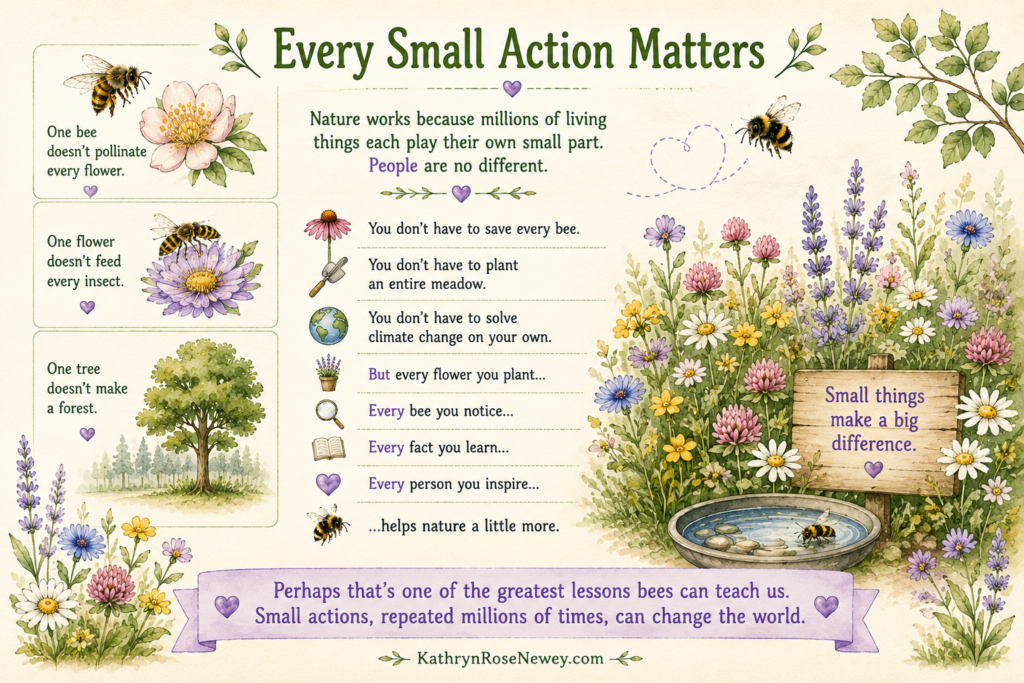
One bee doesn’t pollinate every flower.
One flower doesn’t feed every insect.
One tree doesn’t make a forest.
Nature works because millions of living things each play their own small part.
People are no different.
You don’t have to save every bee.
You don’t have to plant an entire meadow.
You don’t have to solve climate change on your own.
But every flower you plant…
Every bee you notice…
Every fact you learn…
Every person you inspire…
…helps nature a little more.
Perhaps that’s one of the greatest lessons bees can teach us.
Small actions, repeated millions of times, can change the world.
Keep Exploring Nature With Me
If you’ve enjoyed learning about bees and pollinators, I’d love to help you continue your journey of discovery.
🌿 Join the Eco Wonder Club (Free)

Sign up for my Eco Wonder Club newsletters and I’ll send you my Hedgehogs Poster & Worksheets Pack as a welcome gift.
You’ll also receive Eco Wonder newsletters full of:
- fascinating wildlife facts
- eco-friendly activities
- seasonal nature ideas
- updates about new books and educational resources
- inspiration to help young people connect with the natural world
🦋 Download the Bee & Pollinator Spotter Checklist
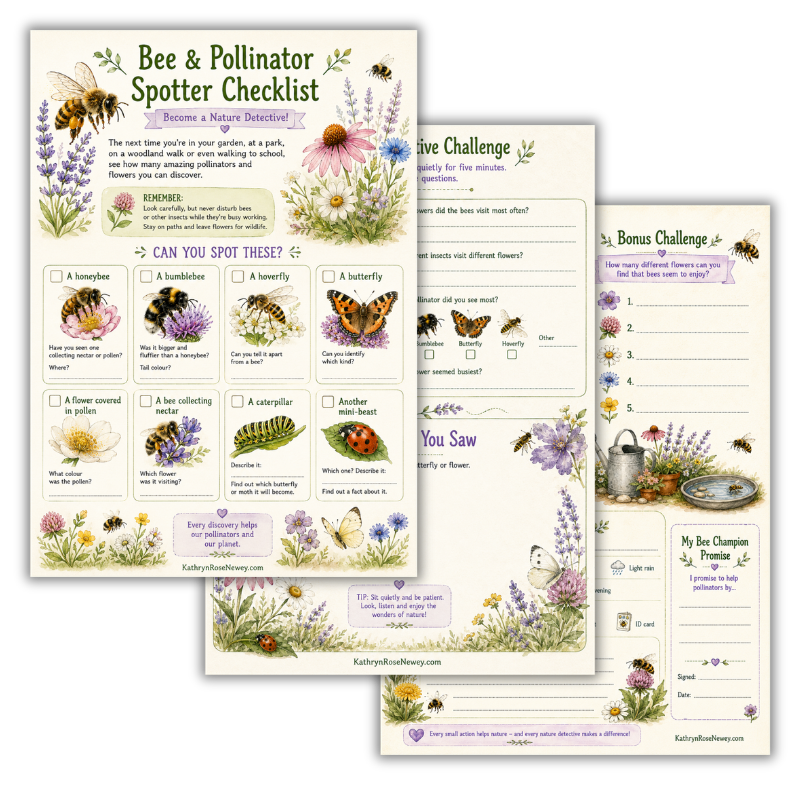
Take the Nature Detective Challenge
Turn what you have learned into a real outdoor activity with my free Bee & Pollinator Spotter Checklist. Use it in the garden, at the park, on a nature walk or even on the journey to school. Children can record the pollinators they spot, watch which flowers bees prefer and choose simple actions to help them.
This free checklist is one activity from my Eco Wonder resources. Eco Wonder Community members receive access to the complete resource library, including worksheets, posters, diagrams and new learning activities.
Simply fill in your name and email address in the yellow form above, in the ‘Try This’ section, to get this 3-page checklist for free!
🐝 Want to Learn Even More About Pollinators?
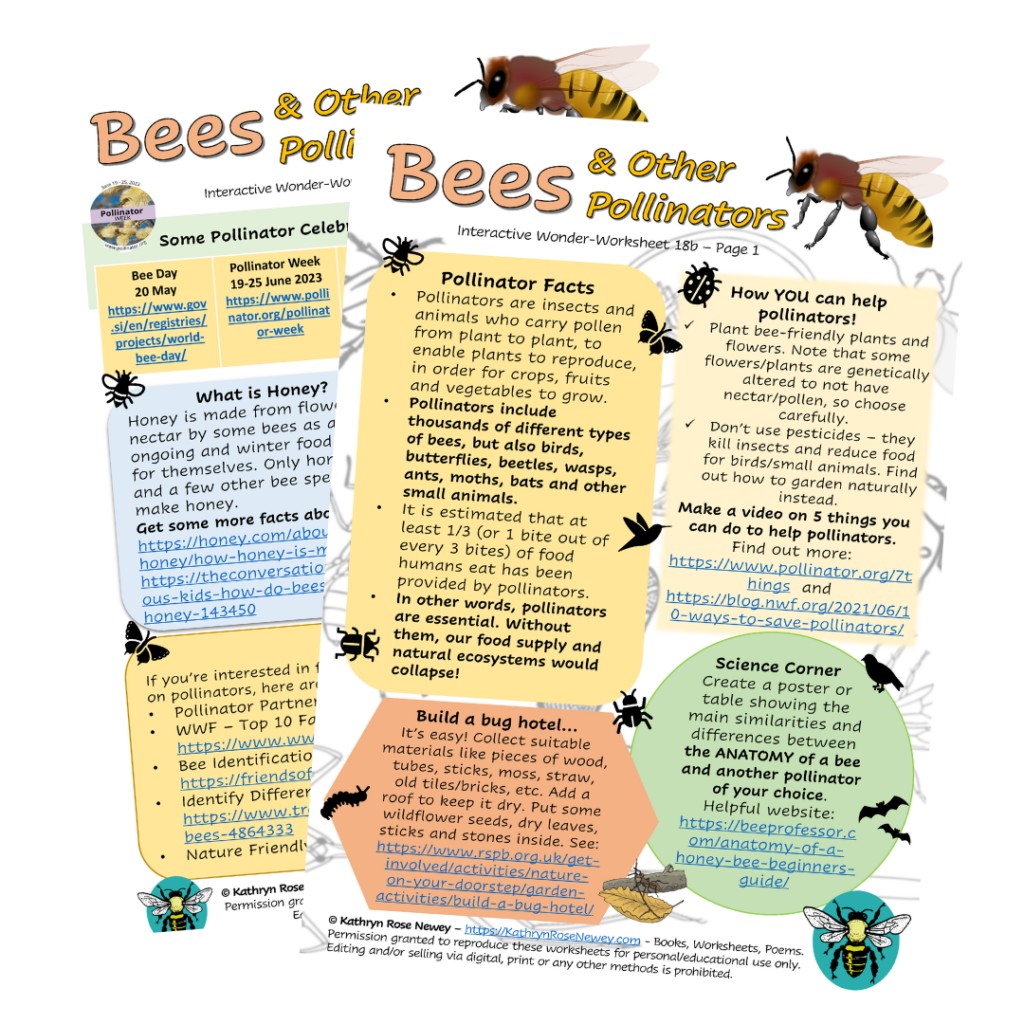
Members of my Eco Wonder Community can also access my Bees and Other Pollinators worksheet.
Designed for children aged approximately 9–14, it includes research activities, discussion questions and fun learning tasks that complement this article perfectly.
📚 Discover My Environmental Novels
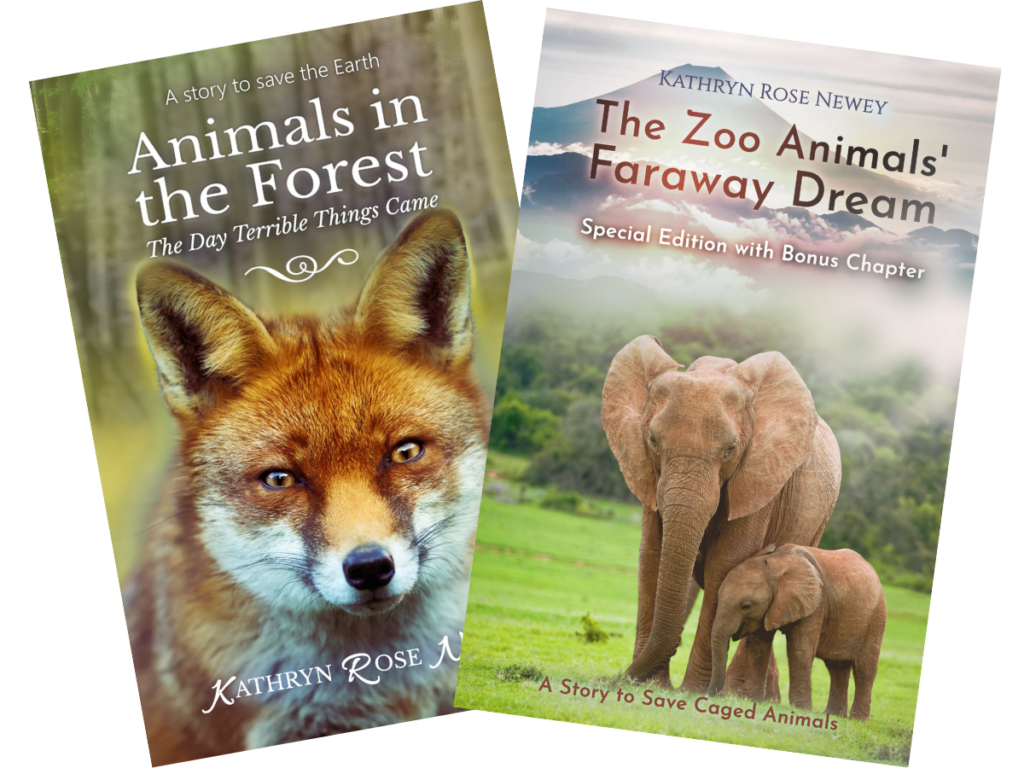
If you enjoy stories that inspire children to care about wildlife and our planet, explore my environmentally themed novels, where adventure, imagination and real environmental issues come together.
Further Reading & Trusted Sources
This article was researched using information from the following trusted organisations and educational resources.
United Nations
World Bee Day – Background
Why bees and other pollinators are essential for biodiversity, food security and sustainable development.
https://www.un.org/en/observances/bee-day/background
Friends of the Earth
Bee Identification Guide
Learn how to recognise common UK bee species and discover practical ways to help pollinators.
https://friendsoftheearth.uk/nature/bee-identification-guide
Earth.org
What Happens to Ecosystems When Bees Disappear?
An accessible explanation of how declining bee populations affect ecosystems and food production.
https://earth.org/what-happens-to-ecosystems-when-bees-disappear/
HoneyBee & Co.
Educational information about bees, pollination and the fascinating ways different bee species help plants reproduce.
https://honeybeeandco.uk/bees/
About the Author
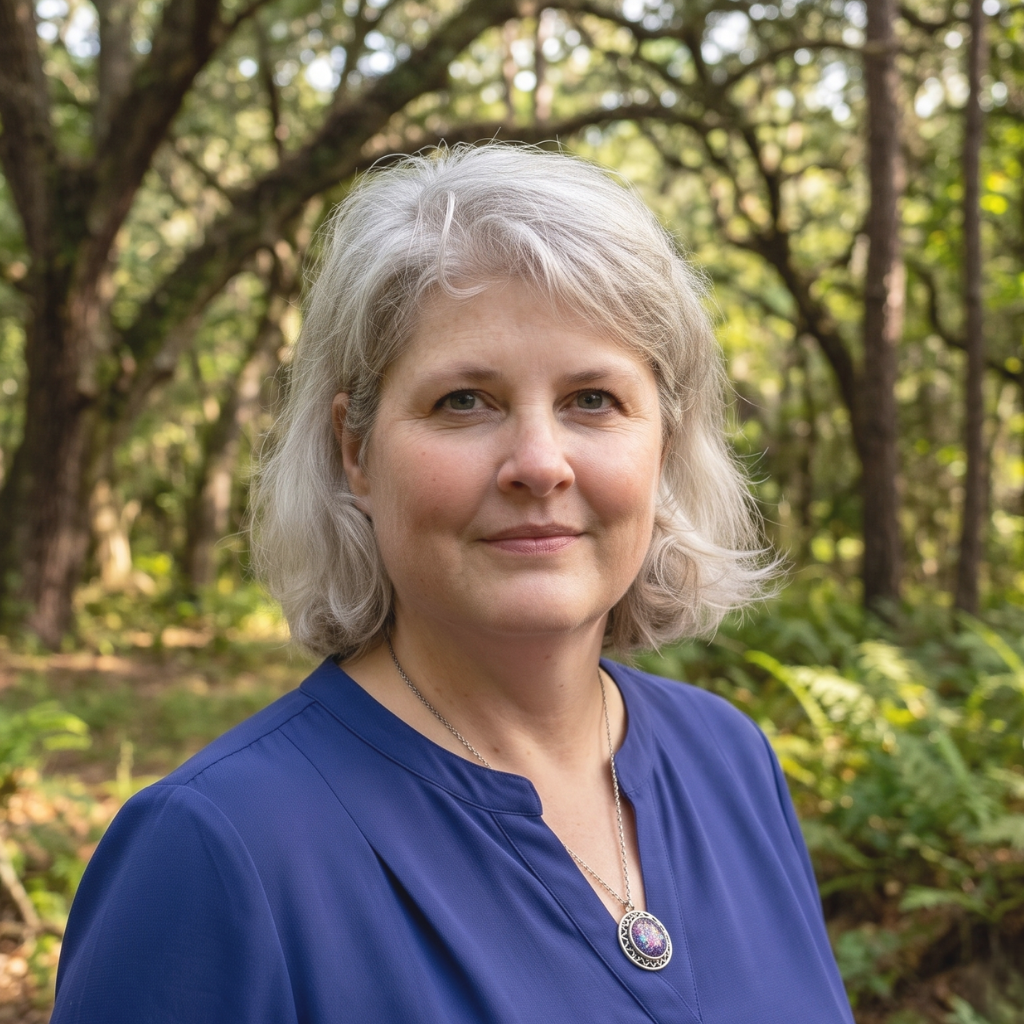
Kathryn Rose Newey is a UK children’s author writing environmental fiction and educational resources for children aged approximately 9–14. Through novels, worksheets and Eco Wonder educational resources, she encourages young readers to explore nature with curiosity, compassion and hope.